Partial Knee Replacement
Partial Knee Replacement Surgery
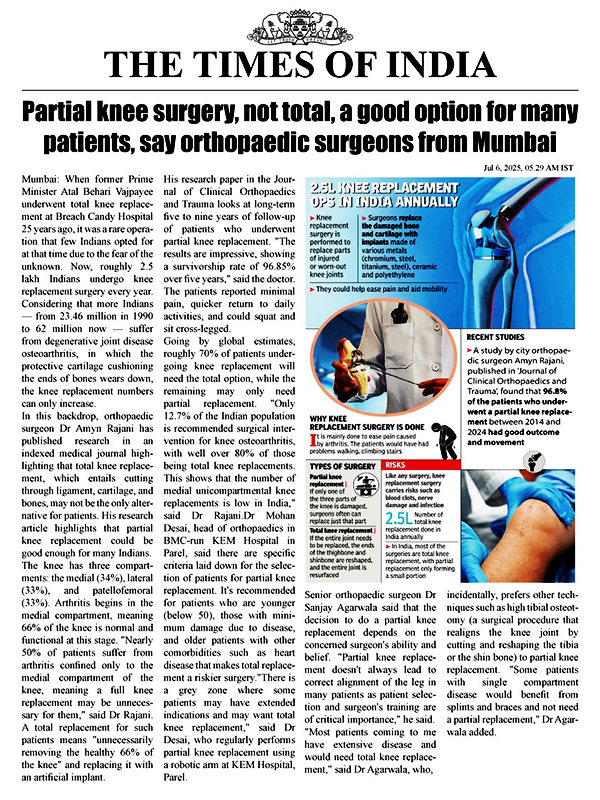
Partial knee replacement - also called unicompartmental knee arthroplasty (UKA) - replaces only the damaged section of the knee rather than the entire joint. It suits patients whose arthritis is confined to one compartment of the knee. Most people manage basic walking within a few weeks. Full functional recovery typically takes 6 to 12 weeks, though this varies with age, overall health, and how well rehabilitation is followed.
What Is Partial Knee Replacement?
Partial knee replacement surgery removes and replaces only the arthritic compartment of the knee. The healthy cartilage, ligaments, and bone in the remaining compartments are left untouched.
The knee has three compartments:
- The medial compartment (inner side of the knee)
- The lateral compartment (outer side of the knee)
- The patellofemoral compartment (between the kneecap and thigh bone)
Most partial replacements address the medial compartment, where arthritis most commonly develops.
Partial vs. Total Knee Replacement: A Practical Comparison
Patients often ask whether they need a partial or total replacement. The honest answer depends on how many compartments are affected, not on what sounds simpler.
| Factor | Partial Knee Replacement | Total Knee Replacement |
| Bone removed | Only the damaged compartment | All three compartments replaced |
| Incision size | Smaller incision | Larger incision |
| Recovery time | Generally faster | Longer rehabilitation period |
| Suitable for | Single-compartment arthritis | Severe, multi-compartment disease |
| Implant size | Smaller implant | Larger implant system |
| Revision risk | May require conversion later | Lower long-term revision rate in advanced OA |
For a closer look at total knee replacement, see our page on total knee replacement surgery.
Who Is a Good Candidate for Partial Knee Replacement?
A partial knee replacement operation may suit patients who meet certain criteria. The treating surgeon will assess this thoroughly before recommending anything.
Typical indicators include:
- Arthritis confined to a single knee compartment (confirmed on imaging)
- Intact ligaments, particularly the anterior cruciate ligament (ACL)
- Knee pain that has not responded adequately to physiotherapy, injections, or medication
- Good range of motion at the knee
- No significant deformity
Who May Not Be Suitable?
This procedure is not appropriate for everyone with knee pain. Partial knee replacement may not be recommended when:
- Arthritis affects more than one compartment
- The ACL is absent or significantly damaged
- There is marked knee deformity or instability
- Inflammatory arthritis (such as rheumatoid arthritis) is the underlying cause
- Obesity significantly increases the mechanical load on the joint
An honest assessment at consultation helps avoid choosing a procedure that will not hold up well long-term.
Alternatives to Surgery
Surgery is not always the first step. Before considering a partial knee replacement procedure, many patients benefit from:
- Physiotherapy and specific strengthening exercises
- Weight management, which reduces load on the knee significantly
- Corticosteroid or hyaluronic acid injections
- Bracing and activity modification
- Oral anti-inflammatory medications
High tibial osteotomy (HTO) is another surgical option for some patients. See our page on HTO surgery for more information.
The Partial Knee Replacement Procedure
The partial knee replacement surgery is performed under general or regional anaesthesia. The surgeon makes a smaller incision compared to total knee replacement. Only the damaged bone and cartilage from the affected compartment are removed.
A small implant - consisting of a metal component on the femur (thigh bone) and the tibia (shin bone), with a plastic spacer in between - is fitted into the prepared area. Healthy tissue surrounding the joint is preserved throughout.
Operating time typically ranges from 60 to 90 minutes. Most patients are up and bearing weight on the same day or the next morning.
Robotic assistance is now available for partial knee replacement surgery. Learn more about our robotic partial knee replacement programme.
Recovery After Partial Knee Replacement
Recovery timelines vary between patients. Factors such as age, muscle strength, body weight, general health, and commitment to physiotherapy all affect how quickly function returns.
General recovery milestones as a guide:
- Day 1 to 2: Most patients stand and walk short distances with support
- Week 2 to 4: Walking without significant support becomes more comfortable for most people
- Week 6 to 12: Return to most daily activities, including driving (depending on which leg was operated on and surgical guidance)
- 3 to 6 months: Return to low-impact activities such as walking, cycling, and swimming
These are typical ranges, not guarantees. Individual recovery depends on several variables.
Our knee rehabilitation programme outlines the stages of recovery and physiotherapy in more detail.
Research Insight From Dr Amyn Rajani's Work
Dr Rajani and his colleagues investigated an issue that affects some patients undergoing partial knee replacement: the role of the mucoid ACL.
A mucoid ACL is one in which the ligament appears degenerated or gelatinous on imaging, though it may still be functionally present. Their study, published in Knee Surgery & Related Research (2022), examined whether debulking this mucoid ACL during unicompartmental knee arthroplasty improved outcomes.
The researchers found that addressing the mucoid ACL at the time of surgery may have a positive influence on results. This work is relevant because ACL integrity is a key prerequisite for a partial knee replacement to function well long-term.
In a separate study published in the Malaysian Orthopaedic Journal (June 2024), Dr Rajani and co-authors investigated whether correcting pre-operative vitamin D3 deficiency reduced postoperative bone pain in patients undergoing unicompartmental knee arthroplasty. The study found that addressing vitamin D3 deficiency before surgery may help control bone pain after the procedure.
This is a practical and patient-relevant finding. Patients who are identified as vitamin D3 deficient before surgery may benefit from correction prior to the operation.
View Dr Rajani's full list of publications on the scientific publications page.
Possible Risks and Complications
Partial knee replacement surgery carries real risks. They are relatively uncommon but should be understood before making any decision.
- Infection at the wound or around the implant
- Blood clots (deep vein thrombosis or pulmonary embolism)
- Stiffness that requires physiotherapy or additional intervention
- Progression of arthritis to another compartment over time
- Implant loosening or wear in the longer term
- Nerve or blood vessel injury (rare)
- Conversion to total knee replacement at a later stage
A case report from Dr Rajani's team, published in the Journal of Orthopaedic Case Reports (2022), documented a pseudoaneurysm of the lateral genicular artery following unicompartmental knee arthroplasty - a very rare vascular complication. Awareness of such cases helps experienced surgeons remain alert to unusual presentations after surgery.
See the full section on complications of partial knee replacement for a complete overview.
When to Seek Urgent Advice After Surgery
Contact your surgical team promptly if you notice:
- Increasing swelling, redness, or warmth around the wound
- Calf pain or swelling (potential blood clot)
- Breathlessness or chest pain
- Persistent fever above 38°C
- Sudden sharp increase in knee pain
These are warning signs, not a diagnosis. Assessment by your treating team is needed.
Implant Longevity: What the Research Suggests
A common question is how long a partial knee implant is expected to last.
Published data from registries and clinical studies suggests that well-selected patients can expect around 10 to 15 years of satisfactory function from a unicompartmental implant. Some studies report longer survival rates.
Important caveats apply. Outcomes depend on patient selection, activity level, body weight, implant type, and surgical technique. Younger, more active patients may place higher demands on the implant.
If the implant does fail over time, conversion to a total knee replacement is possible, though the surgery is more complex than a primary total knee replacement.
Frequently Asked Questions About Partial Knee Replacement
How painful is partial knee replacement surgery?
Some discomfort is expected in the first few weeks. Most patients find the pain manageable with prescribed medication. Pain typically reduces steadily over the first month. Individual experience varies considerably.
How soon can I walk after partial knee replacement?
Most patients stand and take a few steps with support on the day of surgery or the following day. Walking more comfortably without a frame usually takes 2 to 4 weeks, though this depends on individual progress.
Will I need physiotherapy?
Yes. Physiotherapy is an important part of recovery. It helps restore strength, range of motion, and functional walking. The intensity and duration of physiotherapy varies depending on the patient's baseline fitness and progress.
Can partial knee replacement fail?
Yes. Reasons for failure include implant loosening, disease progression to other compartments, infection, and mechanical problems. Conversion to total knee replacement may be needed. Regular follow-up helps identify concerns early.
Is partial knee replacement better than total knee replacement?
Neither is universally better. Partial replacement suits patients with single-compartment disease and intact ligaments. Total replacement is more appropriate when arthritis is widespread. Patient selection, not procedure preference, determines the right choice.
What is the recovery time for partial knee replacement surgery?
Most people return to light daily activities within 6 to 12 weeks. Recovery to fuller function may take 3 to 6 months. The timeline depends on age, fitness, body weight, and adherence to rehabilitation.