FAQs of High Tibal Osteotomy Surgery
Q: What is the purpose of a High Tibial Osteotomy?
A High Tbial Osteotomy distributes the stress of weight-bearing across the Knee more evenly. It relieves excessive pressure on the diseased (or arthritic) side of the Knee Joint.

Q: What is the recovery time for a High Tibial Osteotomy?
3 weeks of nil weight-bearing, followed by six weeks of minimal weight-bearing with crutches and 12 weeks of rehabilitation with physical therapy. Many patients return to their usual activities by about six months. Recovery varies, and some activities may stay limited.
Q: What evaluation do I need before a High Tibial Osteotomy?
You will need full length x-rays and a physical examination.
Q: Is Total Knee Replacement Surgery difficult after an HTO procedure?
Total Knee Replacement Surgery is very much possible after an HTO. The only difference is that it becomes a more difficult surgery as compared to a Primary Total Knee Replacement Surgery. Also it involves the removal of plate and screws put earlier in the tibia for the union of the HTO. This can be done as a first stage surgery followed by a Knee Replacement or both procedures can be done in the same sitting.
Q: Is Osteotomy more painful than Total Knee Replacement?
Pain after both operations is usually similar and generally settles over the first few weeks. Recovery varies between patients.
Q: What are the long term results of High Tibial Osteotomy?
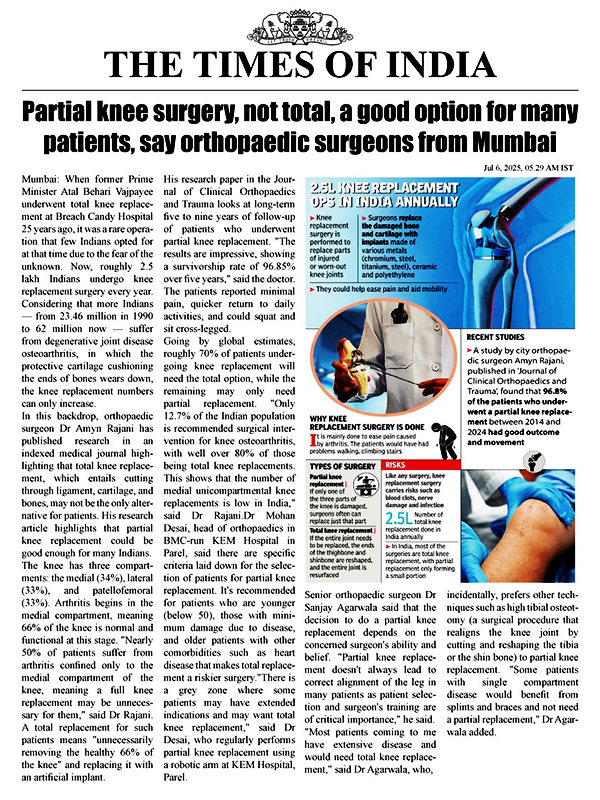
This Knee Surgery is indicated for young people with arthritis of the Knee and is often used as a stop gap operation to delay Joint Replacement. Various studies have shown that majority of the pain can be relieved for up to 10 years but after that period a Knee Replacement is often required. Performing a High Tibial Osteotomy avoids the risks of putting an Artificial Knee Joint in a young patient which may need to be changed after 10-15 years. The restrictions on the activity following a High Tibial Osteotomy Surgery are also often less than that following a Knee Replacement.
Why is HTO performed less often than knee replacement?
Since the results depend on accuracy of correction, the ability to correct deformities accurately within one or two degrees of normalcy is a skill not developed in surgeons in general.
The implants used in HTO generally cost less than knee replacement implants.
This operation is generally suited to younger, active patients with osteoarthritis in only one compartment.